"Getting my varifocal glasses made in just 72 hours really surprised me."
— Mrs.L, SwitzerlandAfter Cataract Surgery, Needing Reading or Progressive Glasses Is Completely Normal
Mrs.L had cataract surgery — a procedure that, in modern ophthalmology, is routine and highly successful. The clouded natural lens of each eye was removed and replaced with an intraocular lens implant, or IOL. The surgery went well. Her vision improved substantially. But cataract surgery, even when perfectly executed, rarely eliminates the need for glasses entirely. The IOL is chosen before the operation based on the patient's anatomy and lifestyle, and while surgeons aim for the best possible outcome, a residual prescription almost always remains — sometimes a small cylinder for astigmatism, sometimes a slight sphere power for fine distance or near correction.
Mrs.L's residual prescription was small — which is precisely what made it difficult to address. In Switzerland, she had been to an excellent optician and trusted the care she received there. While travelling through Thailand, she happened to walk past the Optical X shop and stopped to ask a simple question: could we make her a pair of varifocal (progressive) glasses from the prescription she already had, and if so, how long would it take? Parson, one of our opticians, explained that a new pair could be ready in just three days.
Her prescription called for -0.37 diopters — a value that doesn't sit on the standard 0.25D scale most labs work in (-0.25, -0.50, -0.75, and so on). In Thailand, most Japanese lens brands only manufacture in 0.25D steps; producing true half-steps such as 0.12, 0.37, 0.62, or 0.87 requires one of the few European brands capable of that resolution — Zeiss, Rodenstock, or Shamir. Zeiss and Rodenstock typically need 3–10 days to produce a pair at this resolution, while Shamir could deliver within the three-day window Mrs.L needed. We recommended the Shamir Autograph Intouch — a lens designed with a notably wide intermediate and near zone, well suited to her lifestyle.
Measured to the Half-Step
After cataract surgery, unless a multifocal IOL was implanted, the eye is left with a single, fixed focal point. In practice, this typically shows up as a standard near addition of around +2.50 diopters for reading at roughly 40cm — the eye can no longer accommodate the way it once did before surgery. Mrs.L's case carried an extra layer on top of that standard add: a small residual sphere and cylinder — the -0.37D that had made her original Swiss prescription so hard to match exactly. What she needed in Bangkok was for the full prescription, near add and residual correction alike, to be reproduced accurately. The optometrist at Optical X began a refraction protocol suited to IOL patients: methodical, unhurried, and working in 0.12 diopter increments rather than the standard 0.25.
Mrs.L's refraction at Optical X produced a prescription that differed from her previous glasses at the level of 0.12 diopters in one axis. She tried on the corrective trial lenses. The difference, she said, was immediate and clear — the kind of clarity that had been just slightly out of reach despite her previous attempts. She did not rush the decision — she tested the trial lenses for twenty minutes, reading different types of text at different distances. Satisfied with what she experienced, she placed the order before leaving the shop.
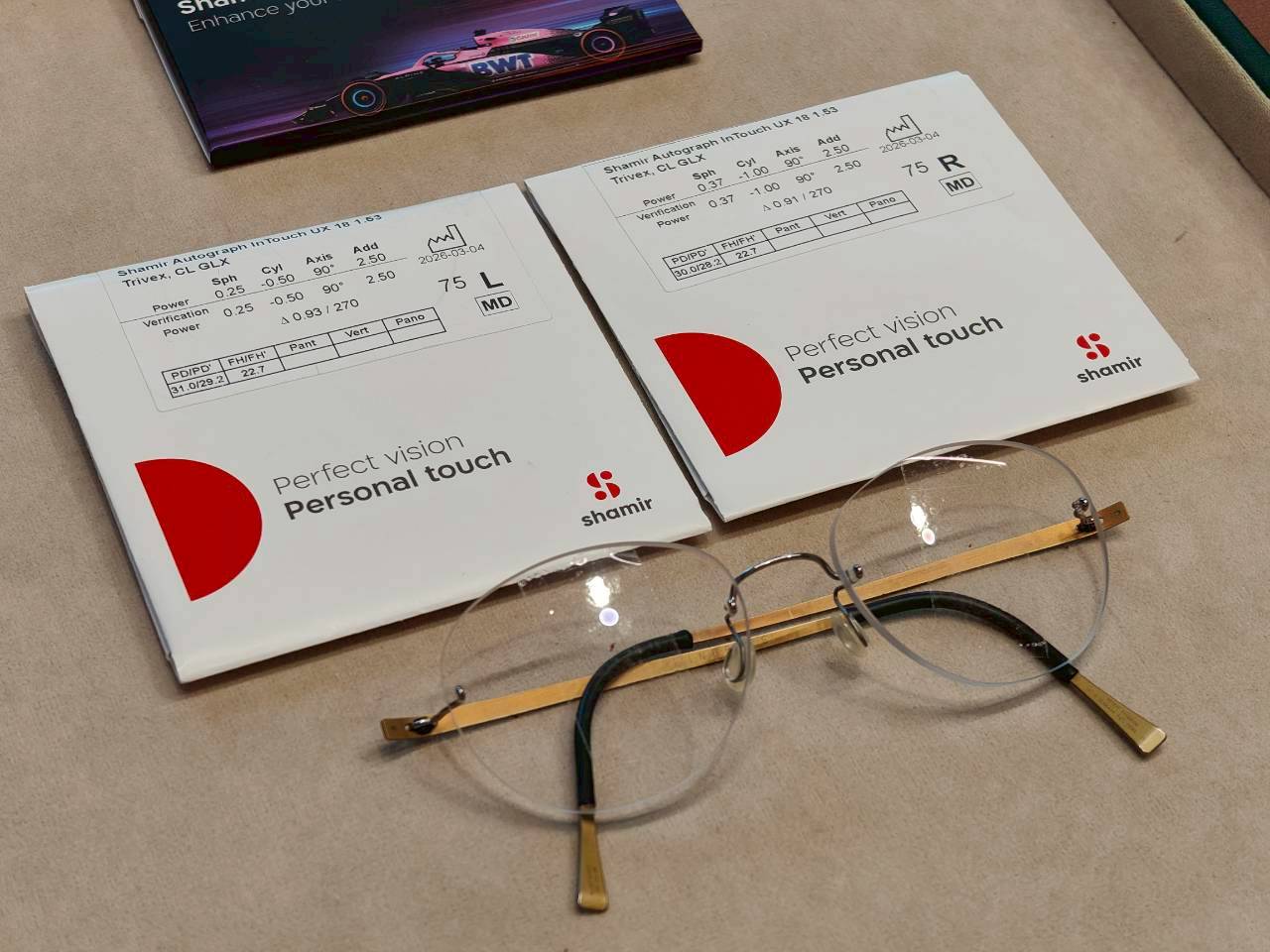
Measured to 0.12D — the resolution most opticians round away
Optical X performs refraction to 0.12 diopter resolution — half the standard industry step — using a full set of half-step trial lenses. The examination also accounts for post-surgical factors including potential induced astigmatism, altered corneal curvature, and IOL-related optical aberrations that can affect outcomes in standard testing protocols.
Nine Months Later, She Came Back for a Second Pair

Mrs.L returned to Optical X nine months after her first visit, this time ordering two additional pairs of glasses: a pair of sunglasses and a pair of clear progressive lenses, both set in ultra-lightweight Lindberg frames. Each pair used the same precisely measured prescription from her first visit. She mentioned, without any prompting, that the glasses from that first visit had been the clearest she had worn since before her surgery.
The return visit is, in many ways, the more significant data point. Returning customers are the result of trust earned through quality, not marketing — trust that takes time to confirm in daily use across weeks and months. Mrs.L had tested her glasses in her own life, in Zurich, over nine months, and had concluded that they were worth returning to Bangkok for. That is a meaningful signal.
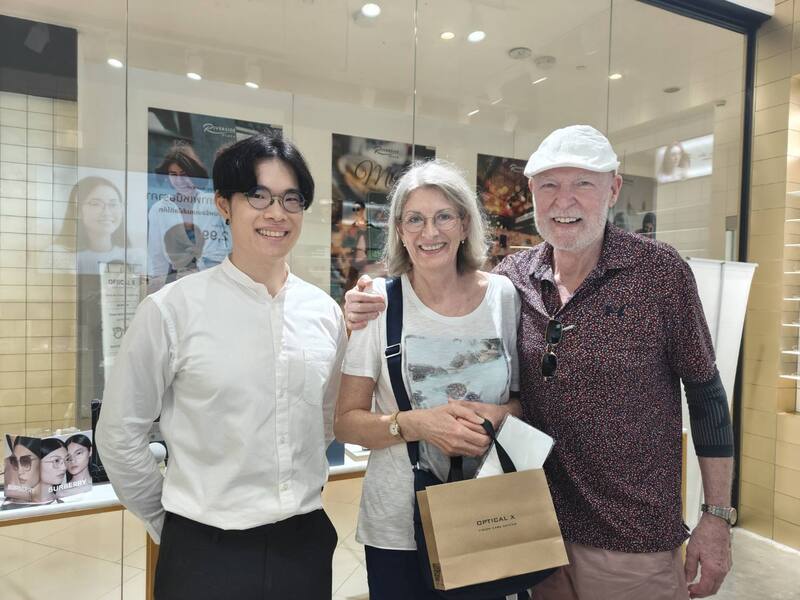
Back at Optical X nine months later — picking up her Lindberg progressive and sunglasses pairs
We had also mentioned to Mrs.L, during her first visit, that having progressive lenses made in Thailand tends to be both faster and more affordable than back home in Switzerland. Hearing that her glasses had held up beautifully over nine months of daily use — and that the value matched the quality — was exactly the outcome we hope for. We were glad to welcome her back.
If Your Post-Surgery Glasses Have Never Felt Quite Right
If you have had cataract surgery and your corrective glasses have never felt as sharp as you expected, it is worth considering whether your refraction was performed at sufficient resolution. The 0.25 diopter standard is appropriate for the vast majority of patients — but for post-IOL eyes with small residual prescriptions, measuring in finer steps can make a clinically meaningful difference. If you are traveling through Bangkok, a precision refraction appointment at Optical X takes less than an hour and may produce the clarity that has so far been just slightly out of reach.
What Changed for Mrs.L
- First genuinely sharp vision since cataract surgery — achieved through 0.12D precision refraction
- Prescription differed from previous glasses at the half-diopter level — below the threshold of standard measurement
- Returned 9 months later for a second visit — 2 additional pairs ordered (sunglasses + Lindberg progressive)
- Found progressive lenses in Bangkok faster and more affordable than back home in Switzerland
- Trust built through measurable precision, not promises
Common Questions About Post-Cataract Glasses in Bangkok
At Optical X, a pair of progressive glasses typically takes 72 hours (3 days) to make, even for prescriptions that require half-diopter precision. Sunglasses with progressive lenses take a little longer — about 5 days.
An IOL is a fixed-power implant that cannot flex the way a natural lens does. A 0.25D rounding error that a healthy eye might compensate for neurally can remain a persistent soft edge for an IOL patient — which is why finer 0.12D refraction can make a clinically meaningful difference.
Not all can. Most Japanese lens brands are limited to standard 0.25D steps, while European brands such as Zeiss, Rodenstock, and Shamir can produce true half-steps like 0.12, 0.37, 0.62, and 0.87 diopters.